



























































































Creative Cloud, Lightroom, Acrobat or Substance 3D? Which Adobe Tool Is for You?
 Adobe
Adobe
 Adobe
Adobe
 Adobe
Adobe
 Adobe
Adobe
 Adobe
Adobe
 Adobe
Adobe
 Adobe
Adobe
 Adobe
Adobe
 Adobe
Adobe
 Adobe
Adobe
 Adobe
Adobe
Quick answer: which Adobe software is right for you?
| What do you want to do? | Best choice |
|---|---|
| Use multiple Adobe creative apps | Adobe Creative Cloud All Apps |
| Edit and organise photos | Adobe Lightroom |
| Edit, convert and manage PDFs | Adobe Acrobat Standard |
| Work across a complete 3D workflow | Adobe Substance 3D Collection |
| Texture and paint 3D models | Adobe Substance 3D Painter |
| Photography plus advanced image manipulation | Lightroom + Photoshop / Creative Cloud |
| Game assets and realistic 3D materials | Substance 3D Painter or Substance 3D Collection |
If you already know what you need, you can go straight to the relevant product. If not, keep reading - the differences matter more than they first appear.
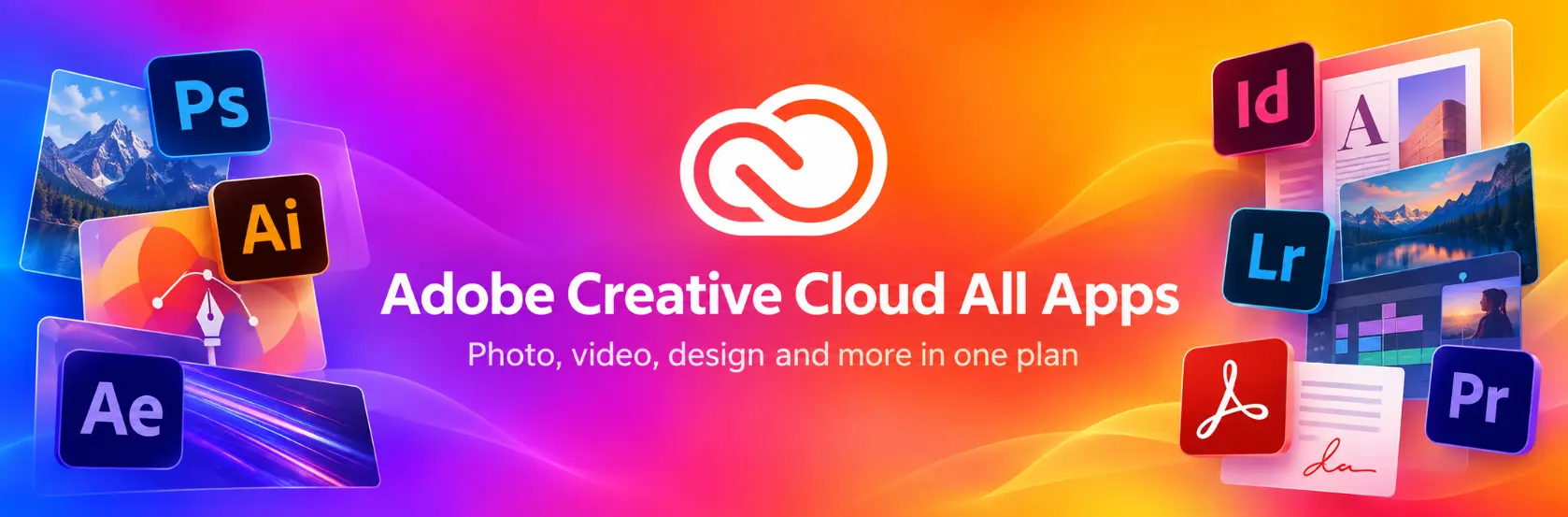
Adobe Creative Cloud All Apps: best when you need more than one creative tool
Adobe Creative Cloud is Adobe's ecosystem of creative applications and services. The all-apps plan is designed for people who regularly work across more than one creative discipline.
Adobe's current full creative plan includes more than 20 applications, including Photoshop, Illustrator, Premiere, After Effects, InDesign and Acrobat.
That makes Adobe Creative Cloud All Apps the most flexible option for:
- graphic designers,
- content creators,
- photographers,
- video editors,
- marketers,
- freelancers,
- students working across different creative projects.
What can you do with Adobe Creative Cloud?
Depending on the applications you use, you can work with:
- photo editing,
- graphic design,
- illustration,
- video editing,
- motion graphics,
- page layouts,
- PDF documents,
- creative assets and fonts.
The biggest advantage is simple: you are not locked into one type of project.
You might edit a photo in Lightroom or Photoshop, create graphics in Illustrator and then prepare a video in Premiere without needing completely separate creative ecosystems.
Who should choose Creative Cloud All Apps?
Choose it if you regularly think:
“I need Photoshop... but I also need something for video, graphics or documents.”
If you only need one specific task, however, the complete collection may be more than you actually need.
Best for: creators using several Adobe applications.
Adobe Lightroom: best for photo editing and organisation
If photography is your main focus, Adobe Lightroom is usually the first Adobe product worth considering.
Lightroom is designed around editing, organising and managing photos. Adobe's current Lightroom tools provide controls for refining images and making detailed adjustments.
Typical Lightroom tasks include:
- adjusting exposure and contrast,
- colour correction,
- improving highlights and shadows,
- cropping and straightening,
- applying consistent edits across multiple photos,
- organising larger photo collections.
Lightroom vs Photoshop: what is the difference?
This is one of the most useful distinctions to understand.
Lightroom is primarily built around photography workflows.
Photoshop goes much further into detailed image manipulation, compositing, layers and graphic creation.
A simple rule:
Editing 300 photos from a trip or photoshoot? → Lightroom
Removing objects, combining images or creating a complex graphic? → Photoshop
If you regularly need both workflows, a broader Creative Cloud option can make more sense.
What about Adobe Photoshop Lightroom?
You may also see products using the older Adobe Photoshop Lightroom naming.
Pay attention to the exact version in the product title. A version-numbered product such as Lightroom 5.7 should not automatically be treated as identical to Adobe's newest Lightroom subscription.
Before purchasing, check:
- Windows compatibility,
- exact version,
- region,
- included licence or subscription period,
- whether the version supports the workflow you need.
Best for: photographers and users who mainly want to improve and organise photos.
Adobe Acrobat Standard: best for everyday PDF editing
Not every Adobe product is about creative design.
Adobe Acrobat Standard is designed for people who regularly work with PDFs and need more than simply opening a document.
Adobe lists functions including PDF editing, conversion, organisation, protection and electronic signing in Acrobat Standard.
You can use it to:
- edit text and images in PDFs,
- convert documents to PDF,
- export PDFs to other formats,
- organise pages,
- protect documents,
- fill and sign forms,
- collect electronic signatures.
Adobe Acrobat Standard vs Adobe Reader
This distinction is especially important.
Adobe Acrobat Reader is primarily the free tool for viewing, printing, sharing and commenting on PDFs.
Acrobat Standard adds actual document editing and productivity tools.
So if all you need to do is open a PDF, Reader may already be enough.
If your workflow sounds more like:
“I need to change this PDF, convert it, organise the pages and sign it.”
then Acrobat Standard is the more appropriate option.
Who is Acrobat Standard for?
It works especially well for:
- students,
- office users,
- freelancers,
- administration,
- remote work,
- anyone frequently exchanging PDF documents.
Best for: practical PDF workflows without buying an entire creative suite.
Adobe Substance 3D: what is it?
This is where Adobe's product names become a little easier to confuse.
Adobe Substance 3D is Adobe's ecosystem of professional tools for working with 3D materials, textures, models and scenes.
It is aimed at users such as:
- 3D artists,
- game developers,
- environment artists,
- product designers,
- VFX creators,
- visualisation specialists.
The important point is that Adobe Substance 3D is not simply another name for Substance 3D Painter.
Painter is one application inside the broader Substance ecosystem.
Adobe Substance 3D Collection: the complete 3D toolkit
If you need several stages of the 3D workflow rather than only texturing, Adobe Substance 3D Collection is the broader option.
Adobe currently lists tools such as:
- Substance 3D Painter,
- Substance 3D Designer,
- Substance 3D Sampler,
- Substance 3D Stager,
- Substance 3D Modeler,
- Substance 3D Assets.
Adobe also confirms that Substance 3D applications are sold through Substance plans rather than being automatically included in regular Creative Cloud plans.
That distinction is particularly useful if you are comparing Creative Cloud All Apps vs Substance 3D Collection.
What can the Substance 3D Collection be used for?
Typical workflows include:
- creating materials,
- texturing models,
- building game assets,
- preparing product visualisations,
- creating 3D scenes,
- developing realistic surfaces,
- working across several stages of 3D production.
Who should choose Substance 3D Collection?
Choose the collection when Painter alone would not cover your workflow.
For example, if you want to create materials, texture assets and then prepare complete scenes, having the wider Substance ecosystem makes more sense.
Best for: serious 3D workflows requiring several specialised applications.
Adobe Substance 3D Painter: best for texturing 3D models
Adobe Substance 3D Painter has a much more specific job.
It is primarily a tool for adding materials, textures and surface details directly to 3D models.
A useful way to understand it is:
Painter is a bit like Photoshop for the surface of a 3D model.
Imagine you already have a 3D sword.
The model defines its shape. Painter helps make that sword look like real metal by adding:
- scratches,
- wear,
- dirt,
- rust,
- colour,
- surface variation.
The same applies to characters, armour, vehicles, buildings and environmental assets.
Substance 3D Painter for game development
Painter is especially useful when creating visual details for game assets.
A character model might need:
- skin,
- fabric,
- leather,
- armour,
- dirt and wear.
A weapon might need:
- metal,
- scratches,
- painted surfaces,
- battle damage.
That makes Substance 3D Painter particularly relevant for game artists and anyone creating detailed 3D assets.
Adobe Substance 3D vs Substance 3D Painter: which one should you buy?
This is the simplest way to look at it:
| Adobe Substance 3D Collection | Adobe Substance 3D Painter |
|---|---|
| Complete group of 3D tools | Individual application |
| Covers several parts of 3D creation | Focuses mainly on texturing |
| Better for complete 3D workflows | Better when you already have models |
| Includes multiple Substance applications | Painter only |
| Best for 3D creators using several tools | Best for texture artists and game assets |
Need only professional 3D texturing? → Substance 3D Painter
Need a broader 3D workflow? → Substance 3D Collection
This difference is worth understanding before paying for a larger package you may not actually need.
Before buying Adobe software: check these details first
Two Adobe products with similar names can still be very different.
Before choosing an offer, check:
-
Product name and edition
Creative Cloud, Lightroom, Acrobat and Substance serve very different purposes. -
Subscription duration
Check whether the listing covers one month, several months or another licence period. -
Region
Look for GLOBAL, Europe, ROW or another regional designation. -
Operating system and device
This is especially important for older or version-specific software. -
Exact version
A Lightroom 5.7 listing, for example, should not automatically be treated as the current Lightroom release. -
What is actually included
Do not assume that every Adobe application is included just because a product uses the Adobe or Creative Cloud branding.
This takes less than a minute and makes choosing the right product much easier.
Adobe Software Comparison
| Product | Best for | Main use |
|---|---|---|
| Adobe Creative Cloud All Apps | Multi-discipline creators | Complete creative workflow |
| Adobe Lightroom | Photographers | Photo editing and organisation |
| Adobe Acrobat Standard | Students, office users, freelancers | PDF editing and document management |
| Adobe Substance 3D Collection | 3D professionals | Complete 3D workflow |
| Adobe Substance 3D Painter | 3D and game artists | Texturing 3D models |
Find the Right Adobe Software on Gameseal
There is no single “best Adobe app”.
The best option is the one that matches your workflow.
Photos → Lightroom
PDFs → Acrobat Standard
Multiple creative apps → Creative Cloud All Apps
Complete 3D workflow → Substance 3D Collection
3D texturing → Substance 3D Painter
Compare the available editions, regions and subscription periods before choosing.