




















































































































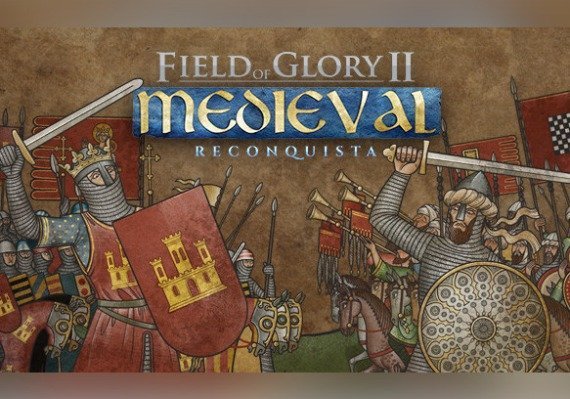












Field of Glory II: Medieval - Reconquista (DLC) (PC) Steam Key - GLOBAL
This bundle includes the following:
- From 1040 to 1270, 20 more countries and groups governed Spain, Italy, and North Africa. These include the Andalusian, Almohad, Arab, Aragonese, Castilian/Leónese, Catalan, Granadian, Hafsid, Italian Guelf, Italian Ghibelline, Italo-Norman, Lombard, Marinid, Murabit, Navarrese, Papal, Portuguese, Kingdom of Sicily, and Tuareg peoples. Each of these has a banner that reflects historical events.
- 41 more units were added, giving the army of each new group a coherent picture.
- Added 45 army lists enabling historically accurate armies for every one of the aforementioned factions and their allies at various points of time, increasing the total number of medieval army lists to 103. Additionally, contingents from former allies may be present in an army. This results in more than 50,000 permutations. There are always fresh matchups to test.
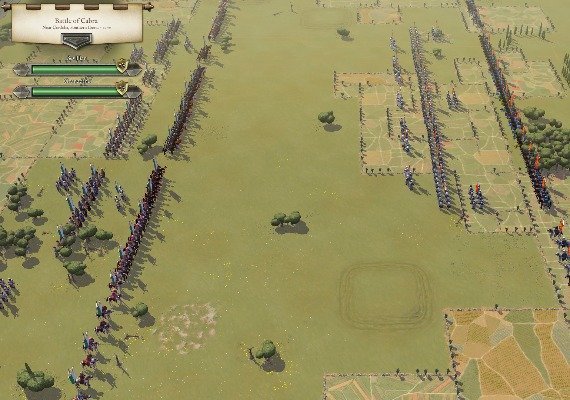
- 8 additional historical scenarios depict major battles from the era on an epic scale. These include Benevento 1266, Legnano 1176, Las Navas De Tolosa 1212, Montaperti 1260, Civitate 1053, Monte Maggiore 1041, Cabra 1079, Sagrajas 1086, and Legnano 1086.
- The number of playable historical matchups in Quick Battle mode has increased by 33 to 98.
- El Cid, Muhammad II of Granada, the Normans in the South, and Frederick II Hohenstaufen are among the four other historically based campaigns that include significant figures and wars of the time.
- You can now lead any nation (and its historical allies) against any other nation (and their allies) in the enlarged Sandbox campaign, offering thousands of permutations.
Reconquista era
Spain and Italy did not experience feudalism to the same extent as North West Europe. Each of these nations had distinctive characteristics that shaped how the conflict was fought.
More over half of the Iberian Peninsula, often known as Andalusia, was ruled by Islamic powers in 1050. Andalusia was split up into a number of little Muslim republics known as the Taifa emirates after the fall of the Umayyad Caliphate in 1031. The Taifas frequently engaged in internal strife, which prevented them from competing with the bigger Christian Kingdom of Castile, which was formed in 1037 with the incorporation of the Kingdom of Leon.
The Christian Reconquista, which would not be finished until 1492, had its actual beginning at this time. The Taifa Emir of Seville asked the Murabit Berbers of North Africa to invade Spain in 1086 in an effort to fend off the Christian invasion. This did not go as the Taifas had intended, as the Murabits swiftly absorbed the majority of the Taifa emirates into their empire after defeating the Castilians at the Battle of Sagrajas.
In the year 1147, a competing Berber sect known as the Almohads overthrew the Murabit dynasty. The Christian kingdoms of Spain suffered a major loss as a result of these occurrences, but they bounced back to triumph against the Almohads at Las Navas de Tolosa in 1212, permanently ending the dominance of the Muslims in Spain. Only the emirate of Granada remained soon, but it was now a vassal state of Castile. During this time, conflicts between states of the same religion also occurred often, and Muslim and Christian warriors frequently had no qualms about serving kings of other religions.
Creating the new Italy
The major cities in Northern Italy have always fought vehemently against the Holy Roman Emperor's attempts to impose his authority over them in order to maintain some degree of independence. By the end of the 11th century, their city militias had replaced the feudal knights as the backbone of Italian armies as a result of their increased income from trade. At the Battle of Legnano in 1176, the northern Italian cities known as the Lombard League triumphed over Emperor Frederick I Barbarossa.
This took place during the Guelf and Ghibelline Wars. The "Investiture Controversy" refers to the early dispute between the Papacy and the Empire over who had the authority to name church officials. In contrast to the Guelfs, who backed the Pope, the Ghibellines were the group that favored the Holy Roman Emperor. Although the Investiture Controversy was finally settled in 1122, the war between the Papacy and the Empire, as well as the Guelfs and Ghibellines, continued for hundreds of years.
After taking the island from the Arabs, the Normans in southern Italy rose from being meek mercenaries to conquer the entire region and build the mighty kingdom of Sicily. When William II, the last of the Norman monarchs, died without male heirs, the kingdom was taken over by the Imperial German Hohenstaufen dynasty. Charles of Anjou attacked the Hohenstaufens in 1266 with the help of the Pope, and after winning the Battle of Benevento, Charles of Anjou took control of the kingdom.